



Golden thread
The table of contents must be complete and logically consistent. It reflects the structure of your paper: a meaningful, systematic sequence that covers the topic coherently. In a well-structured paper, subpoints connect logically rather than simply following one another. This logical structure is what your table of contents makes visible — a principle sometimes called the golden thread, known in German as the red thread.


Objectives and structure
The structure reflected in your table of contents should be self-explanatory. Each heading should give readers an immediate sense of what the chapter or subchapter covers. Clear chapter headings are usually more than one or two words long. Keep your headings concise but as precise as possible.
Depending on the scope and topic of your paper, three to four levels of hierarchy are usually enough; two levels often work just as well. Too many subpoints fragment your paper and suggest that related topics have not been grouped effectively.
The length of individual sections depends on their content, so aim for a reasonable balance across your chapters.

Your outline is a tool for organizing your text. Once you have revised your draft, finalize your chapter structure and headings before setting them out in the table of contents.

Common mistakes to avoid
- The structure of your paper does not suit the subject of your work.
- Topics are not clearly differentiated: main points do not form a logical frame for the subpoints, and subpoints are not mutually exclusive.
- Your table of contents contains residual categories such as “Other.” Consider where this content can be integrated more effectively.
- The research question is used as the heading of a section or the introduction.
- Page numbers are missing.
- Only one subpoint appears under a heading.

Best practice
- Each section heading establishes the organizing principle for the subpoints below it: the upper tier forms a logical frame around the levels beneath.
- Subpoints are mutually exclusive in content.
- A chapter with subpoints must contain at least two.
- The subpoints carry roughly equal content weight.


Example of a Table of Contents
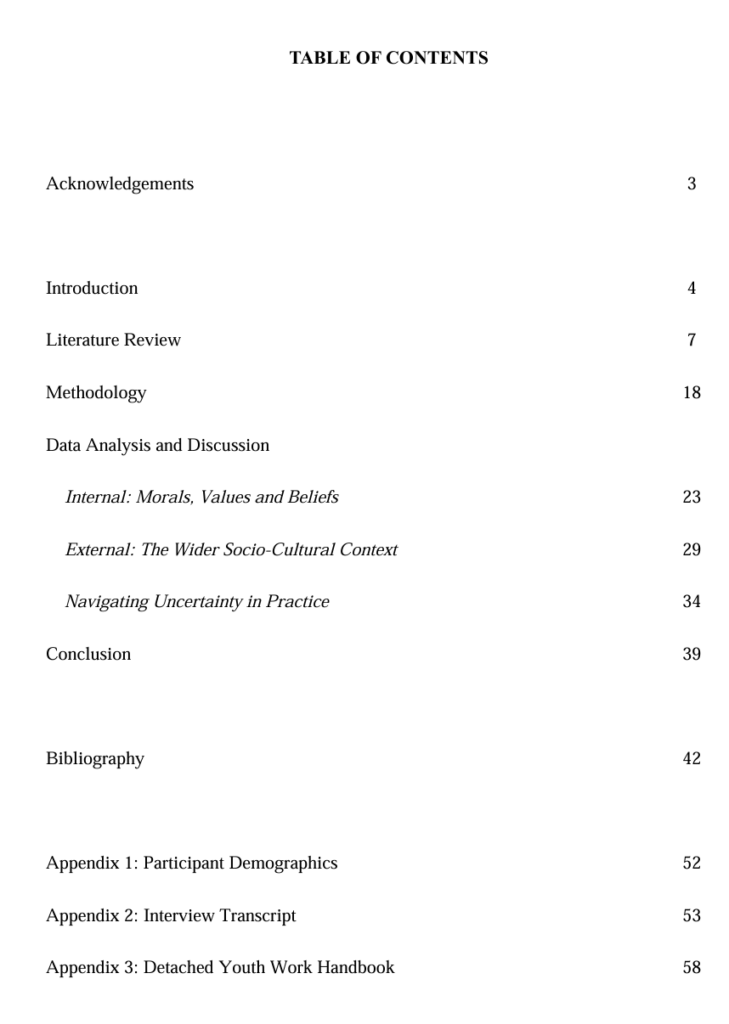

Further examples of tables of contents for the Master of Social Work degree are available here:

Frequently Asked Questions
What makes a good table of contents?
Your table of contents must be complete, clear, and logically structured: Chapter headings and subsections relate to each other, a golden thread is visible, and readers can easily navigate through your work.
How do I divide my table of contents?
Depending on the length of the paper, dividing it into a maximum of three to four sections ensures clarity. Often, two sections are sufficient. Warning: Too many subsections fragment the paper and show that related topics were not grouped effectively.
Related Articles

This article was published in August 2025 and last updated in April 2025.