


Before you start
To write a good term paper, it helps to bring curiosity and interest in the topic. It is useful to be able to answer the following questions:
- Can you choose the topic and research question yourself?
- When is your submission deadline?
- Do you know what your lecturers expect from you?
- What framework conditions exist (length, formalities, submission format)?
It is best to start by noting what you already know and gathering additional information. At the same time, you can begin taking the first steps for your term paper.

Some lecturers publish assessment grids that clearly show what is expected.

Tip: Focus Writing
Focus Writing simply means writing continuously for five or ten minutes – on a topic or a question, without thinking too much about what and how you write. Write forward, without correcting or worrying about spelling and grammar.
What you write is only for yourself. This allows you to warm up, generate surprising ideas, or simply write off your frustration before the actual writing begins. And then you are already in the writing flow – writing and writing and writing.
- What do I already know about the topic?
- What do I want to know?
- What is my position on it?

Create a schedule
Do you have 15 minutes? Then it’s best to make a rough schedule for your term paper now. Rough, because it will probably change anyway. Still, it is good to have a plan.
- When is your submission deadline? Enter it and plan backward from there.
- Which steps are necessary? Make a list. Typical steps are: find a topic – read in – formulate research question – research systematically – create preliminary outline – draft text – revise – finalize
- Estimate how long each phase will take. Don’t be surprised if it takes longer – this is completely normal.
- Arrange feedback appointments with your lecturer, tutors, friends, or fellow students.
- Plan buffers. Life will also get in the way.
- Reserve fixed times in your calendar to focus only on your term paper.

In reality, the writing process is often chaotic and full of processes running in parallel and repeating constantly. As mentioned, this is completely normal.

Finding your topic

Often your topic is not completely free, but is connected to the course topic. If it is freely selectable and you have no idea yet, consider the following questions (writing down your thoughts):
- What is currently being discussed in the academic field or current politics?
- What annoys you?
- Which problem are you confronted with?
- Where do you say a statement cannot possibly be true?
- Which question preoccupies you?
- What causes do you support (e.g. voluntarily)?
- What do you want/need to do in your studies anyway?
- What have you already discussed extensively?
- What surprised you?
- What do you want to do professionally?
What is the topic? Which aspects interest you the most? To find out, a technique such as clustering can be helpful. Give it a try!

Develop your research question
The research question will be the guiding star for your term paper. It is the touchstone that decides which aspects and arguments belong in your paper – and which do not. Usually, it takes some time to find an individually suitable research question, as it is connected with a systematic literature review. Design your research question so that there is enough literature available in this area.
Example of narrowing down a topic:

Important: In addition to your main research question, there are also sub-questions that structure your term paper. Read more about the difference between topic, title, and research question in our OWL article Topic – Title – Research Question: Does it make a difference?.
Tell someone about your topic and engage in discussion. Observe yourself: What exactly interests me? Be as concrete as possible, have clear examples, and then try to align your research question with them.
With whom?
- Friend
- Fellow students
- Family
- Tutors for academic writing or politics
- Tutors from the Writing Center

Start your research
Collect literature related to your research question – this can include books, scholarly articles, studies, statistical data, or project reports from practical institutions. Use databases and the OPAC – Google and a AI tool alone are unfortunately not enough.

Tips:
- Use the snowball method: Identify a central source that exactly fits your research question and then check its bibliography for further relevant sources.
- For library literature: Obtain your materials early and keep an eye on the end of the loan period!
- While reading, take notes that you can later use in your paper: quotes, arguments, thoughts, questions.
Further information on research can be found in our OWL article Starting your research. Library staff are also available to help you.

Are you at home and can’t access the OPAC? Here you can find a guide for online access outside the campus (VPN; EZProxy).
Work through the Table of Contents
For each selected book, read the table of contents: Use Post-Its to mark which chapters are relevant to your research question. Spend 5 minutes per book.
Create a document in which you use one page per book:
- Note the bibliographic information at the top of the page (at least author, year, title)
- Which chapters interest me, and why?
- Later, supplement the document while reading the book by assigning arguments and quotes (always with page numbers!)
Alternatively, you can use an index card system or Zotero for this purpose.
Define the structure
Even though different instructors have different requirements, all academic papers are similar in their structure: There is an introduction, a main part consisting of several chapters, and a conclusion.
A detailed explanation of the typical elements of a term paper can be found in our OWL article The Structure of a Paper in the Social Sciences.
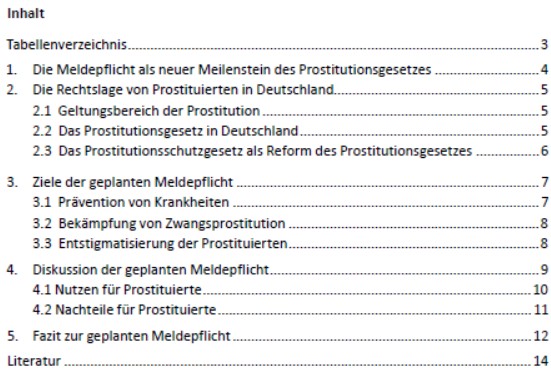
Here is an example of a finished table of contents of a term paper. Chapter 1 corresponds to the introduction, 2 to 4 to the main part, and 5 to the conclusion. If you want, consider what the research question of this paper might be.
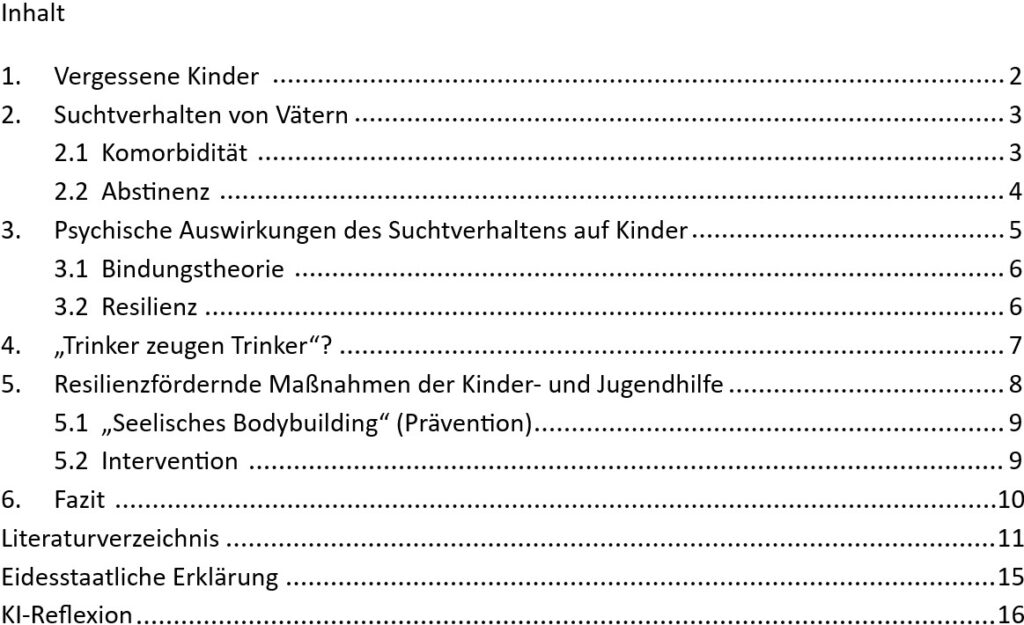
Here is another table of contents from a student term paper. What do you find good about this structure, and what would you maybe do differently?
Create a Preliminary Structure with Post-its (15 Minutes)
- Write each aspect that you think belongs to the term paper on a Post-it.
- Then sort the Post-its thematically and try to arrange them in an argumentative order.
- Be critical: Does this belong to the research question? Increase the spacing between the Post-its: What is missing?
- Document the order with photos.
When you are finished, you may already have your structure in front of you. If it is difficult to decide what belongs and what does not, you can ask yourself the following questions:
- Is your research question still too vague?
- Can you refine the research question using the insights from sorting your Post-its?
It is also useful to discuss the structure. Explain to another person why you placed each point where you did.

Citing sources
In general, always look for the best source! Trace the origin of knowledge and cite from original texts whenever possible. Brockhaus, lecture scripts, or Wikipedia, for example, are not citable.
Citable, on the other hand, is the Dictionary of Social Work (full text via VPN connection).
The difference between citable and worth-citing sources is explained in our OWL article Using the Right Sources. This video also explains why we cite at all.
Browse: Literature Search by Faculties and Databases
- Browse the literature search by faculties.
- Note interesting keywords as a list or cluster.
Important databases for the social sciences:
- Social science topics: Sowiport, Wiso-Net
- Educational topics: German Education Index
- Psychological topics: PsyJournals
- Legal issues: Beck-online
- English or internationally oriented searches: EBSCO (Academic Search Elite), ERIC
- Statistics: Statista

Creating the bibliography
It contains the full bibliographic details of the sources cited in the text, alphabetically sorted. Two examples:
Monograph: Butterwegge, Carolin (2010): Poverty among children with a migration background. Extent, manifestations, and causes. Wiesbaden: VS Verlag für Sozialwissenschaften.
Edited book entry: Flemming, Helga von (2017): Altruism. In: Dieter Kreft & Ingrid Mielenz (Eds.-Connection): Dictionary of Social Work. Tasks, practice fields, concepts, and methods of social work and social pedagogy (8th rev. and updated ed., p. 89). Weinheim: Beltz Juventa.
How to list other types of sources in the bibliography can be found in our OWL article The Bibliography in Social Sciences.

Getting started with writing
Procrastinating, getting distracted, or getting lost – there are some pitfalls on the way to writing your paper, but also helpful strategies and concepts to move you forward. If you already have a plan: let’s go!

Good formulation
Language in academic texts should be:
- factual – not personal
- supported – with references to sources or data, or well justified
- neutral – not judgmental
- precise and unambiguous
- concise – remove unnecessary content
- formal – not too casual
Examples can be found in our OWL article Language in Social Science Texts.
Tip: Online Course: Academic Language in Social Work Texts (45 minutes).

You are not alone
- Talk to others about writing and get text feedback.
- Take advantage of the support offered by your instructors.
- Use the library’s services (e.g., reference help and training materials).
- Attend the writing consultation of the Writing Center.
- Check the Social Sciences Academic Writing Guide. This guide is also the basis for many OWL articles!
- Form a writing group: In some modules (1.9 Political Science Basics and 1.1 Academic Writing) instructors initiate writing groups. Or simply join with fellow students on your own.

Writing with AI
AI tools like ChatGPT, Gemini, and others can write, summarize, or rephrase texts. When writing a paper, AI tools can help you:
- ask questions about the structure of your paper,
- formulate or revise a draft,
- find examples of academic phrasing,
- check spelling, grammar, and citation style,
- get feedback on style or readability.
But:
- Always check the content. AI can provide inaccurate, false, outdated, or made-up information.
- Follow your instructors’ rules: clarify if and how AI use should be documented.
- Writing is thinking. If AI does everything, you miss a learning opportunity. For your first paper, it might be a good idea to practice academic techniques manually first.
More information in our OWL article Using AI as a Writing Buddy.

Frequently asked questions
What can help me with my research?
Use the snowball method: Find a central source and then look in its bibliography for additional useful sources.
Is the structure of a paper always the same?
All academic papers are similar in structure: An introduction, a main part consisting of multiple chapters, and a conclusion. Ask your instructors if they have specific requirements for the structure.
Related Articles


This article was published in August 2025 and last updated in May 2025.